Thursday, June 15, 2006

Nicaraguan Tourism

Hi Everybody,


Well, predictably, since Tom showed up on May 30, I’ve been really busy with things that I’m observing at the cooperative.  In consequence, Tom has spent a lot of time in the hammock, reading, practicing his guitar, and wandering around Matagalpa on his own.  We got away for a mini-vacation last weekend, though, going to the beach and to Granada, Nicaragua’s “backpack Mecca”, according to my guidebook.  It is a beautiful little city, and we had fun hiking and paddling around an archipelago of the enormous Lake Cocibolca in kayaks. But as obvious tourists (tall, light-skinned, wearing good shoes and talking with funny accents) we were treated with obvious kid gloves.  Restaurant owners shooed beggars away from us, and there was even a pretty heavy presence of police with “policía turística” (tourism police) written on their uniforms.  We saw them inspecting restaurants, and we felt safe in assuming their main job was not to keep the tourists in line.  At the beach at San Juan del Sur, I’m not sure we saw any Nicaraguan-born people—our hostel was full of these incredibly tall, incredibly tanned, incredibly blond surf gods and goddesses.  When we feel like going to the beach again, I’ll probably search out a much less-touristed place, even if it means less convenient transportation. 


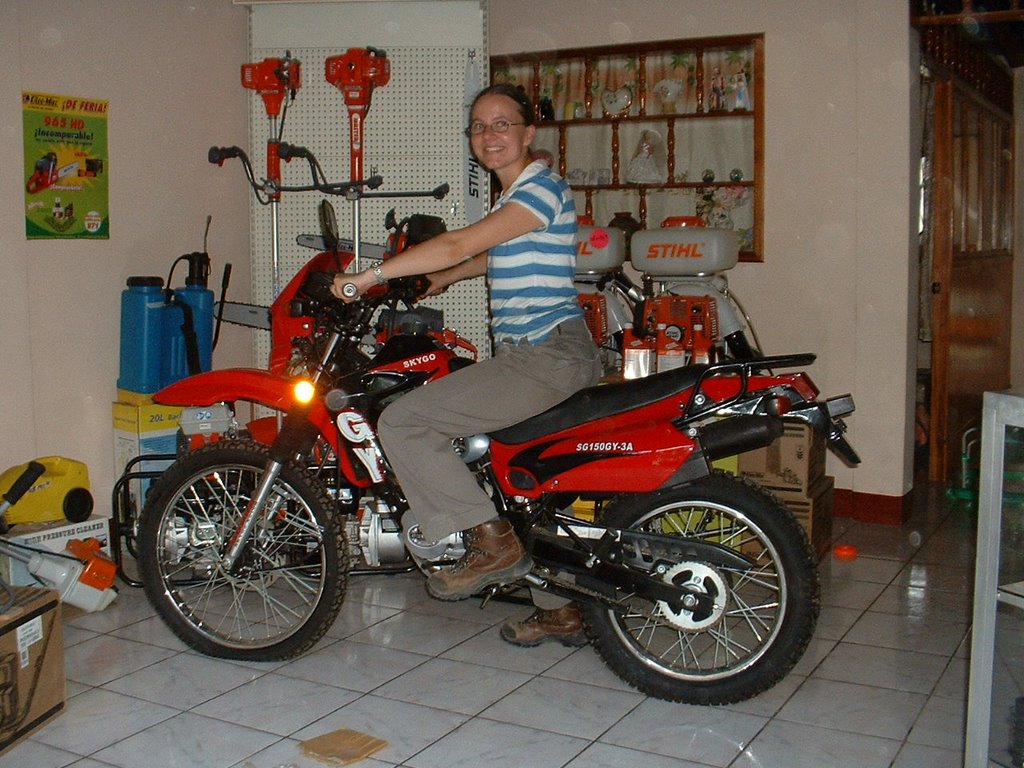
Transportation for the two of us, unfortunately, hasn’t been made any easier by my motorcycle.  I had a mechanic lower the shocks so that I could more easily reach the ground, but this has made it so the poor thing can’t really handle the weight of the two of us.  So Tom patiently folds himself into the seats of the fleet of underpowered second-hand United States school buses that makes up the bulk of the public transportation in the country.  I really love these buses, actually, despite the many discomforts.  Most of the time, the new owners have made a lot of modifications—luggage racks are welded onto the top for bulky bags and agricultural products, a radio and speakers are installed, a handle runs down the ceiling over the center aisle, and there are usually racks above the passenger’s heads for smaller bags.  They almost always have air horns.  The outsides of the buses are often painted, with the bus’s usual destinations prominent on the front and back, and there is usually a name, either of the bus or of its driver, or a phrase saying things like “God Bless this Bus and its Passengers.”  Some bus owners also decorate the insides, with colorful fringes across the top of the windshield, cloth seat covers, and ribbons wrapped around the steering wheel, door-opening lever, and inside luggage racks.  In this way we lurch around and through the potholes, passengers crowded together clutching children, bags, and the occasional chicken, Reggaeton dance music blaring, ribbons swinging.  On steep hills, pedestrians sometimes outdistance us. 


Hmm, I actually intended this entry to be about the organic certification inspector, whom I observed for two days last week.  Hopefully I’ll get a chance to post about him soon.


-Carrie

Tuesday, May 23, 2006

religion in el campo

Hi Everybody,

I spent the last few days up in the campo, but now I'm in the city,
enjoying time off, privacy, and food that isn't beans. Not that I
have anything against beans. But they get old after eating them three
meals a day. I also seem to have caught a cold, so I've been spending
a little bit of time sniffling, feeling sorry for myself, and drinking
tea. Being sick is much less fun when my husband isn't around to fuss
over me. But speaking of Tom, he'll be here in a week! I imagine
that I'll be making less-frequent blog entries when he's around, since
I tend to talk out most of my ideas with him, and writing seems like
more of a repetitive chore than a necessary aid to thought.

The woman I stay with in the campo is very involved in her local
Catholic church. There is a shortage of priests in the area (probably
made worse by the terrible transportation situation), so lay leaders
get designated to be "delegates of the faith" and to lead services,
including mass where they take communion. My hostess is one of these.
In the month of May, the community goes to every house belonging to
church members in the community, taking one day at each house. A
statue of the Virgin Mary is brought, and people gather to sing, hear
a sermon and some readings, and pray the rosary together. It makes
for a busy schedule with several hours every afternoon devoted to this
schedule, but it's only for a month. It's also fun to gather and
sing—these gatherings are not seen as burdensome. An interesting
thing for me about these ceremonies is that they take place in every
house, including the poorest. (Probably I caught my cold germs from
gathering with forty other people into any of several 10 ft by 10 ft
dirt-floored, poorly-ventilated rooms for two hours.) Those who can
afford it provide food—the owner of one of the biggest farms in the
area gave us a meal of rice, chicken, tortillas, and coffee, while a
more normal thing is to have coffee and sweet bread. Sometimes the
poorest houses don't give out anything. And the food given is always
reported back. If someone didn't go, they will ask the returning
attendees how it was, and these will reply, "they gave us bread and
coffee."

Tomorrow, my hosts will be hosting a rather more elaborate version of
this ceremony, which will last not just a couple of hours in the
afternoon but all day and half the night (until midnight, probably,
they told me, but times are usually wild estimates). They are hoping
to serve both a meal and bread and coffee at different times. I do
not get the impression that they are richer than their immediate
neighbors—they do not have much land, and only a few other
money-making activities, none of which I can imagine produce much in
the way of profit (except, perhaps, for hosting me, and I'm not
predictable). But they are definitely both in leadership positions of
the community. The husband is both the president of the cooperative
and what I guess I'll translate as deputy mayor. The wife is a leader
in the church, like I said. They both have wide family networks
throughout the community, and live centrally, where people are
constantly dropping in to visit. So it's interesting to think of this
family as working on a project of consolidating these leadership
positions, and this ceremony as a part of that project. When I go
back (I'm going to the ceremony, assuming my cold doesn't get worse),
I'll ask them about how and why they decided to host it.

Not everybody in the community is Catholic, however. There is also a
significant minority of Evangelical protestants. This is common
throughout Central America, where Protestant churches have put in a
lot of evangelizing effort in the last few years—I've read that in
some places in Guatemala, for example, the Protestant population has
reached fifty percent.

I had an interview with an Evangelical leader on Saturday, and he was
anxious to understand my own religious affiliations. This is a
complicated and awkward question for me to answer. Religion is
important here. Atheism and non-church membership, which are seen as
approximately the same thing, are interpreted as symptoms of despair
and nihilism. I am neither an atheist nor a nihilist, but I am not an
official member of any church right now. However, I feel that
organized religion, or its equivalent (such as being a Red Sox fan?)
is a necessary and beautiful part of the human condition, and I both
respect and enjoy it. Really, I very much agree with some of the
Catholic thought I've been hearing, for example about loving your
neighbors as a necessary part of achieving salvation, and the way that
the church, which they worship (at least sort of), is the same as the
group of people that make up the church.

I was raised as a Unitarian Universalist, and suppose I still am one
(it would be hard to disidentify with a religion which tells you to
seek your own truth, even if I wanted to). So I answer any questions
about religion by describing UUism, and don't mention that I don't go
to any church on a regular basis. I say it is a Protestant church,
but not Evangelical, and to my knowledge there aren't any in
Nicaragua. (If somebody knows that there are UU congregations here,
please don't tell me!) So while I'm here, I go to churches where I
have friends. This statement has gotten me invitations to the
Evangelical church, and I think I'm going to try to make a point of
going this Sunday, if I can, both from curiosity to see what it's like
(will there be speaking in tongues?), as a way to get to know some of
the Evangelicals better, and as a strategic move to send a message
that I'm here with the whole community, not just the Catholics.

Finally, I want to tell those of you who remember me in my squeamish,
vegetarian days that I was in the kitchen when my hostess brought in a
dead strangled chicken, feathers and all, and watched her make soup.
I then ate that soup without a qualm, including using hands and teeth
to get the meat off the bones. The next day, I watched the chickens
run around in the yard with the same amount of enjoyment as yesterday.
Aren't I a big girl!

-Carrie

Wednesday, May 17, 2006

How´s the weather?

Hi Everyone,

During the dry season in Nicaragua, it is hot during the day, even up
in the mountains of Matagalpa. But the heat dissipates after the sun
goes down. Sometimes, while sleeping, you might even wish for a light
blanket. Once the sun comes up, you have a few precious hours of
coolness and mist to get things done. The mist burns off and it
starts to really warm up before noon. It is dry and a thin film of
gritty dust covers everything. A conscientious Nicaraguan housekeeper
mops about twice a day, it seems like. (I am not a conscientious
housekeeper!)

I have had to be careful during the dry season—it is not humid, and my
sweat evaporates instantly, so I don't notice the bright sun so much.
I have only been saved from sunburns a couple of times because I
always wear clothes that cover my shoulders and legs—both because of
insects and because of the ubiquitous, monotonous, masculine
commentary.

The last week or so, on the other hand, it has been hotter and humid,
starting earlier and lasting later. There has been a sense of
building meteorological tension. Last week, half the sky was filled
with bright stars, while the other half was flashing with silent,
spectacular cloud lightning. There have been more ants
around—according to my landlord, they have been busy storing up food
in anticipation of the rains.

Farmers, too, have been waiting for the rain with mounting tension.
As the dry season wears on, the earth gets browner and browner,
dustier and dustier. The number of flowering bushes gets fewer. A
small coffee farmer almost always grows other crops, like corn, beans,
and potatoes, sometimes for household consumption, and sometimes also
to sell. But no crops can grow without irrigation, and the only
places with irrigation are the big haciendas, or down on the plains.

Today, finally, it rained. It was the release of a tension that had
been building for weeks, like shattering a glass jar on a tile floor
after hours of swallowing frustration, like the shock of swallowing an
ice-cold drink after a day of physical labor in the dry heat.

It rained at first gently, a misting sprinkle that warned people to
find shelter, then a little harder, so the gutters started to flow,
and then pounding, rattling the tin roofs, flooding the patio,
carrying away what looked like the top inch of the steep dirt road a
few blocks uphill from here. The electricity went out and I, sitting
just inside the door to my patio, moved my chair back out of the
spray, first by about a foot, and then halfway across the room. I
felt a delicious, almost cold breeze touch my hair where it was still
wet from my sweating under my baseball cap. I watched, fascinated, as
the water rose in the gutter in my hall. I would need a raincoat to
get to my bathroom! Would it also flood my bedroom? But before it
got close to overflowing, the rain slackened, and stopped, leaving my
ears ringing, my patio full of puddles, and my body more relaxed than
it has been for a week. If I were a smoker, I would have lit a
cigarette.

I will be leaving tomorrow for almost a week in the campo. I'll be
going on my motorcycle! This morning I practiced going up the road
I'll be taking, and had no problems. During my practice sessions in
the last week, I've come to feel more and more like I'm in charge, not
the beast machine, and my trip this morning has greatly increased my
confidence to the point where my work, rather than my transportation,
is the main thing I'm thinking about.

Wish me luck!

-Carrie

Monday, May 15, 2006

methods and research questions

Hi Everybody,

It's Sunday night, and for one of the first times since I've been in
Nicaragua, I can't sleep. I've had an exciting day—practicing my
motorcycle and an electrical blow out at my house with dramatic sparks
due to some generator being run next door—but I think I'm awake mostly
because I'm thinking about my research. I've been here almost a month
now. Have I made any progress towards answering my research
questions? Am I heading in the right direction? What, in fact, ARE
my research questions?

I spent a lot of the entire year and a half or so before leaving New
York working on writing grant proposals. During this time, I wrote
many research questions, most of them more oriented towards research
that sounded fund-able rather than questions I thought needed
answering, or that I was interested in researching. I was not worried
about this, maybe because of The Anthropology Fieldwork Mystique.
This Mystique goes something along the lines of: nobody ever starts
out with the same questions that they end up answering. The best
research findings come about by accident, luck, and maybe an ineffable
talent on the part of the researcher—certainly nothing to do with
methodical, plodding work. The plodding work is what you do until
you're hit with the good luck, or the inspiration. I've written
before about a different aspect of this mystique, that of the total
denial of self in fieldwork, and how much I reject it. But I seem to
have fallen a bit into this other aspect of the Mystique.

Towards the end of my grant-writing process, I came on a set of
questions that was both interesting to me and possible to write up as
a proposal. These questions had to do with whether fair trade
certified cooperatives, or maybe cooperatives in general, were likely
to increase or decrease inequality in their local communities. This
seems to me an important thing that I would like to both know and
share with the world. Fair trade as a movement tends to make claims
to the effect that it is promoting more equitable development at all
levels, in sharp contrast to conventional coffee trading, which makes
some people rich and other people destitute. Is this really true? Or
is fair trade not really that different from many other development
projects, which have been shown to often lift a select few up into the
middle class, while imposing arbitrary-seeming requirements on the
majority of the population for the few years while the project is
active, and then drifting away, leaving things largely unchanged, but
more unequal.

In the Nicaraguan context, too, I am also interested in asking about
the viability of cooperatives in general. Although cooperatives, I
think, are in style in international development right now, in
Nicaragua there is a particular historical resonance with this
organizational form. During the decade of the 1980s, under the
revolutionary, quasi-socialist (depending on who you talk to)
Sandinista government, most agriculture was collectivized, either by
creating state farms with de jure collective ownership by the workers,
or by having small land owners join together for the purposes of
collective purchasing and marketing. This latter form was called a
cooperative, and cooperatives are today associated by many with the
military draft, the war, the rationing and shortages, and the
hyper-inflation of that decade. For others, it is also associated
with the sense of new possibilities after decades of repressive
dictatorship, and with the social programs put into effect, despite
the economic hardships: a country-wide rural literacy campaign taught
by university students, universal health care, the redistribution of
unoccupied land, and new mobilization for women's rights. This
memory, or vision, is one of a couple reason why there is a
possibility, at least, of the Sandinistas winning the presidential
elections coming up this fall, despite the many uglinesses of the
candidate, Daniel Ortega. (The heavy-handed threats uttered by the
United States ambassador to Nicaragua about what will happen if Daniel
wins may actually be spurring more people to support him.) I wonder
what it would be like to be here if the Sandinistas actually take
power again? Certainly it would be an accident, or luck, which would
qualify me for a piece of the Mystique.

But I was busy fretting about my research questions. As I was saying,
I'm interested in equality and inequality as affected by fair trade
and cooperatives generally. I'm also interested in some more
conventionally "cultural" questions—like what are the differences in
the ways that charity and aid are seen by United States-eans and
Nicaraguans, and how does this affect their ties formed through fair
trade? And what does it mean to people and the economy in the
Matagalpa area that there is an absolutely incredible density of NGOs
and development projects and aid in this area? (All Nicaragua is not
like this, it's just in Matagalpa and surrounds. The more remote you
get, the fewer NGOs. But around here, after learning that I'm
foreign--usually before I even open my mouth--most people want to know
what organization I work for.)

All right, I've written myself into sleepiness now. Maybe tomorrow
I'll post again with some thoughts on how to actually research these
questions, and an evaluation of how I'm doing.

-Carrie

Saturday, May 13, 2006

money and manners

Hi folks,

As I may have mentioned before, there is a big difference in how much
things cost here. When I first showed up, I stayed in a hotel which
charged me 90 cordobas a night for a room with a private bathroom. At
about 17 cordobas equalling one dollar, that works out to about $5.30
per night. If you were really determined, you could probably pay as
much as that for a really good restaurant entrée for one person. A
nice, cheap, filling breakfast will run you about 20 cordobas. The
internet cafés where I get email, read news, and send my blog updates
charge 10 cordobas, or about 59 cents, per hour.

This would make it pretty easy for me to live like a rich person if I
wanted to. And in fact, the way I do live, and the things I have,
pretty much put me into the category of very rich regardless of what I
want. For example, I have a cell phone, and a computer, and a watch,
and of course I have just bought a motorcycle. And people here are
not shy, ever, to anyone, about asking what things cost, or how much
they paid for something. At first this horribly embarassed me, as I
tried to figure out whether to lie, or to wildly justify owning things
(I only have this because it was a gift!), or what, in fact, to do. I
have gotten used to it lately, have stopped trying to lie, and have
acquired a much better memory for prices, out of necessity.

This economic difference has made for some weird and uncomfortable
social dynamics. For example, when I go to a restaurant with a
middle-class family that I am friends with, do I let them pay for me,
as they often insist? (Answer: yes, when they propose we go to the
restaurant. But then I invite them and pay the next time.) When I go
to visit a poor family in the campo, and they bring me a huge plate of
food without asking, do I 1) Try to pay them, running the risk of
insulting them by implying they wouldn't have offered me food if there
wasn't money involved; 2) Bring them some sort of other present, like
meat or pastries; or 3) Just accept the food and not bring it up if
they don't. (Answer: I need to rethink this approach, but usually 1,
and everybody involved gets really embarassed and they reject the
money. Unless I'm also staying the night, in which case a combination
of 1 and 2, but always offering money with lots of awkward protests
until we work out a regular arrangement.)

My first trip to Nicaragua, this was all arranged ahead of time, so I
didn't have to deal with it. But the second trip, when I was on my
own, I started out by insisting on always paying for everything, and
blundered quite a bit. The mistake I made was that although realizing
that I have superior buying power, I didn't realize that to accept a
present, without reciprocating, is to accept a social position of
inferiority. There was quite a lot of anthropological work done on
this, and it seems to be very wide-spread, maybe even universal, in
human cultures.

To understand in an American context: employees receive a Christmas
bonus without feeling a need to reciprocate. Children are not
(usually, until they're adults and earning money) expected to give
their parents gifts which are approximately equal in monetary value to
those they have received. This is because they are in acknowledged
positions of social inferiority. But friends and siblings must
exchange gifts of roughly equal value, or risk generating resentment…
ON BOTH SIDES. If a person gives you gifts of much smaller value than
those you give them, maybe you get annoyed if you are uncharitable, or
maybe you don't care, and feel benevolent and virtuous. But if a
person gives you gifts of much larger value than those you give them,
you are much more likely to feel anxious that they will be annoyed.
You will probably feel anxious to give a bigger gift next time, and
maybe even resentful that they have put you in this position. In some
social contexts without formal political systems, one way a person can
become a leader is by acquiring followers by giving them gifts they
can never hope to reciprocate, thus putting them under permanent
obligation.

So what I have come to realize is that I shouldn't go around paying
for everything if I want to avoid putting myself in the position of
patron and benefactor, socially above the people that I actually want
to be learning from. On the other hand, both some things I can't or
don't want to change about my own position here (stuff I own), and the
positions taken by other foreigners—individuals and institutions—makes
it impossible to get out of that position altogether. Usually, when
foreigners visit the campo, for example, they are there as
representatives of some NGO or other organization which wants to give
things to people and help alieve their poverty. (Have I mentioned
that Nicaragua is the second-poorest country in the Western
Hemisphere? Only Haiti is worse off.) So when I say I want to
understand the economic circumstances of the community, I'm following
a well-worn path. Once I understand these circumstances, the next
step along this road is for me to reveal how my group can help the
community. So people tend to approach me with suggestions for gifts I
could give the community, or programs they need. (For example: The
Catholic church in the rural community of El Castillo wants to buy a
piano. It will cost about a thousand dollars. Any brother/sister
church groups out there who want to donate?)

This is made more complicated by the fact that I am trying NOT to do
abstract research without giving back. I have a commitment to
actually attempt to be a net benefit to the cooperatives, either
through helping them connect to outside resources like grants and
buyers, or through doing research they really need. But so far, more
of the former. When I get introduced to third parties, this tends to
get emphasized, and the research becomes an auxiliary to it. So I
sound more like an NGO than ever.

Striking a balance here is really difficult for me so far. But I've
got a while to figure it out!

-Carrie

Wednesday, May 10, 2006

Fwd: birthday, chickens, motorcycle


Hi Everybody,

My birthday was Monday, and I celebrated by having one incredibly
unproductive interview (with someone who isn't too crazy about me, maybe I'm threatening to his turf?) and by having one very cheerful dinner with some friends. I'm
twenty nine! And for real, not because I don't want everybody to know
that I'm thirty-something! My first prime number age since 23!

This last weekend I spent two nights in the campo, in the house of an
official of the coop. He took me on a short tour of his farm, and among other things told
me all about the approximately million varieties of bananas and
plantains he grows. I also got to have some really great conversations about the local circumstances, the history of the area, etc.

I think the thing that makes it most obvious that I'm not from around
here... besides the fact that I'm tall (no, I'm not kidding) and blond
and have a funny accent... is that I'm just hypnotized by the
chickens. In the campo, and also sometimes in the city, but not so
much, chickens wander in and around the people with a wonderful
freedom. Floors are dirt, and so when it's time to feed the chickens,
for example, people just throw a handful of corn down on the floor.
The chickens rush in and gobble it up. And most of the time they just
wander around and underfoot, unregarded. Chickens are silly! I like
the baby ones best... they run around in groups so they look like a
fast-moving liquid. Awkward adolescent chickens, especially the ones
with the bald, featherless necks, are maybe the funniest. They squawk
the loudest and jump the fastest when someone shoos them away. And
the handsomest ones are the roosters, with big red combs, striding
around calmly. Other animals hang around with the same freedom:
dogs, pigs, sometimes cats. And at a meeting I went to last week, two
children drove large calves through the meeting room as it was
breaking up. The horses and adult cows don't hang out in the house,
thank goodness.

I slept on a cot in the front room of the house. I really like
staying with these people, they're really nice and great to talk to,
but I have a tiny problem with flea bites. I think I must be
allergic, or especially attractive to fleas or something. And I don't
like to bring it up, because I'm VERY reluctant to complain about
conditions, and don't want to do anything stigmatizing. I've heard
that Deet insect repellant can help--we'll see, I'm staying there
again on Friday night. Wish me luck.

And finally... I got my motorcycle! It's going to take some getting
used to--I've scheduled a lot of time in the next week for practice in
controlled conditions before I head out onto the open roads. I also
need to get a mechanic to lower the suspension for me, since it's a
little too high. But it's red! I'm going to try to post a picture of
me on the moto, we'll see if that works.

Thursday, May 04, 2006

el campo

Dear readers,


Yesterday I took my first excursion of this journey into el campo.  For those who don’t speak Spanish, el campo does not mean “the camp”.  El campo means the countryside—and when you’re speaking about Nicaragua, don’t make the mistake of thinking about the countryside as an idyllic, peaceful place where people are one with nature and sheep frolic to the sounds of an adorable shepherd playing pipes.  (Have the people who write about sheep frolicking ever SEEN a sheep?)


El campo in Nicaragua is the place where you will find the deepest poverty.  In the U.S. many people (mistakenly) think of cities as the place where poverty is the most problematic.  But in Nicaragua, people who live in el campo are isolated.  Isolation means no electricity.  It means no telephones.  It means no newspapers.  It means no roads, not even ones where a motorcycle can pass.  We’re talking steep, steep footpaths, and you’d better be wearing your hiking boots because of the mud and loose rocks.  Unless you happen to be a child living nearby and generally do it barefoot.  Isolation means that the nearest school might be 3 hours away… distances are measured in time, just like in the U.S., but in el campo, three hours means three hours walking.  When school is 3 hours away, some children get up very early in the morning and walk.  Alone.  Many other children, too young or too scared or just too tired, don’t go at all.  Illiteracy is way, way too common.


My excuse for going yesterday was that I attended the meeting of a cooperative.  This cooperative is a group of coffee farmers, who created this group in order to take advantage of specialty markets like fair trade and organic.  Getting this group together, and helping the members get the certifications, has been a struggle, largely because of illiteracy.  For example, both organic certification and fair trade certification require that each farm keep a notebook with their work plan.  The inspectors want to know how many days they spend doing various chores around the farm—in the case of fair trade, this is mostly so that the farmers can’t buy coffee from non-certified farmers and pass it off as their own to be able to sell it at the higher price.  But keeping this sort of detailed record is a big barrier for people who can’t read.  Some have children who can do it.  Others muddle through, putting Xs in boxes and getting neighbors and extension service officers to help them.  And some give up.


This meeting they tried to fill an officer’s position which had been vacant.  But in order to fill it and perform the duties, the person has to be literate.  All the literate people already have officer’s positions, and you can’t hold two positions at once.  They finally ended up recruiting a new soon-to-be member, with the understanding that when he joined he’d have this position.  Meanwhile, the room was chock full of members, sitting silently around the edges.  They weren’t asked, and they didn’t volunteer.


I was sitting next to a tiny old lady—standing, the top of her head didn’t reach my shoulder.  (Protein deficiency in childhood causes stunted growth.)  She had a small, brown, wrinkled face and long, long grey hair that she wore braided and pinned up on her head.  During the discussion about the vacant position, she leaned over to me.  “We need someone to come and teach us to read”, she whispered.  “Many people here can’t read—at least, I can’t read.  We need to learn.”  She glanced at my small notebook where I had been scribbling, trying to keep up with what was going on in the meeting.  “Not knowing how to read, it’s like being blind.”  I felt like crying.


The cooperatives are doing good work in these communities.  If nothing else, people come together, and this reduces the isolation.  If all goes well, the cooperatives will also help people receive better prices for their coffee, bargaining directly with importers instead of taking whatever price they can from intermediaries.  Sometimes successful coops can bring social services to the communities.  Like someone to come and teach them to read.


I’m going tomorrow morning to stay for two nights in a different community in el campo.  I hope to do a lot of talking with people, designing an economic household history survey.  I want to know how a family’s economic situation changes over its life cycle—whether young people start out poor and generally get richer and richer, or whether some people start off a little better off and keep that advantage throughout life.  It’s kind of a complicated set of data that I want to collect, so I’m doing a lot of talking and consulting with people to figure out how best to do it.  It’s probable that some of the information I want will have already been collected in the recent census.  At least I hope so!  Keep your fingers crossed for me!


-Carrie


****************************

http://carolynffisher.googlepages.com


Sunday, April 30, 2006

ethnography and self--my defensive manifesto

Hi Everyone,

Well, today's Saturday, and I've got the whole weekend without much to
do, in terms of my research. I've been keeping myself busy around
home, though. I figured out, more or less, how to wash my clothes with
a bucket of water and a scrubbing board. And I got a huge feeling of
satisfaction from seeing my clothes all hung out to dry on the line.
I also have done some work in translating my research proposal into
Spanish, to be able to more easily share it with some professors at
the university in Managua. I'm planning tentatively to make a trip
the second week of May to talk to some of them—I want suggestions and
moral support, and also to do some "networking" and as a courtesy let
them know that I'm here. One of the things about my advisor's career
that I admire and would like to emulate is that he has published many
of his articles in Spanish as well as English and has had a strong
involvement not only in U.S.-based academic debates but also in Latin
America.

I've also done some things to make myself more comfortable in the
house (I feel weird calling it "my house"—I don't want to get too
attached to this place, since I'll only have it for under a year!).
The best thing is that I now have a hammock hanging in the patio. I
hung it up this afternoon, sat down to test it out, and stayed there,
"testing," for almost an hour.

I feel some ambivalence about this house, and about being quite so
comfortable in a place where I'm alone. One classic model for what an
ethnographer does is she goes to a "village", sets up her tent or
moves in with a family, and does her best to become a member of the
"tribe." An important sign of success is when she is "adopted" as a
member of a family or tribe. She does her best to emulate the
behavior and even thought patterns of the people she is studying.
Thus, by an almost mystical act of total empathy and, perhaps,
negation of her own Self, she comes to know the culture with great
authority. This is, of course, a model that has been called into
question in several ways in recent decades by anthropologists, thank
goodness. Maybe I'll talk about them in more detail in a future
entry. But despite this, the model retains a great deal of emotional
authority.

I have attempted a feat like this once before. I spent my junior year
of college in Granada, Spain, living with a family, studying at a
school of the University of Granada, and doing my best to speak as
little English as possible, learning as much Spanish as I could.
Although my conscious objectives were to learn to speak Spanish
better, I came to realize that there is not a clear line between
language and culture. I remember one time I was having a
conversation, in Spanish, with another American student. In the
course of the conversation, I voiced some ugly bigotted joke that I
had heard. When my friend reproached me, it recalled me to my Self
with a shock. It was only then that I realized the degree to which I
had been putting my Self, and certain value judgments which I thought
were pretty close to my core, up for negotiation as part of my project
of learning this language and culture. I'm not going to tell you what
the joke was about, it's still too upsetting to remember, almost nine
years later. There were some very positive things that I absorbed
during that year, too, and I by no means regret the overall
experience. But from that point on, I was more guarded and critical
about what I was willing to try to absorb.

This time, I am not expecting to try to have a totalizing experience
like that. There are a couple of reasons. First, I have a clear goal
in mind this time. I have a dissertation to write, and my
dissertation isn't an attempt to describe culture. I don't have time
and energy to try for a mystical experience of communion. Second, I
am in a permanent relationship. Somebody else has a claim on my Self.
I have a responsibility not to alter it beyond the point where he
won't recognize it. (I know, and know of, so many Anthropologists who
have been through multiple divorces. Is it just statistical, or is it
something to do with the rigors of fieldwork?) Third, I'm just too
damn old to do that again. It's really hard work. By definition it
involves huge emotional highs and lows. I have enough of those in
everyday life anyways, I don't want or need to go seeking them out!
And, maybe, fourth, I actually kinda like who I am right now. Unlike
when I went to Spain.

I do feel ambivalent about this decision, though. Not all
anthropologists will agree that it is a good idea. I've gotten
comments that 9 or 11 months isn't enough time—"you should be there
for AT LEAST a year!!!". But I've made my decision. So there. Hmph.

-Carrie

Thursday, April 27, 2006

house, rapport, motorcycles

Hi Everyone,


Well, I’m moved into my new house, more or less, and am really happy with it.  It’s got a patio with a tree, where I’ll be hanging a hammock very soon.  It’s certainly far bigger than anywhere I’ve ever lived in New York, but doesn’t feel ridiculous for just one person—bedroom, living/dining room, kitchen, and the patio.  There’s a place, in a hall, where there’s no roof—the very clear line between indoors and outdoors, which I’ve taken for granted, is a little blurry.  It makes the place nice and airy, and it will be a novelty for it to be raining “indoors”, when the rains start next month. 


I’ve also started work with the new cooperative, CECOSEMAC.  One of the first things I’ve been doing this week is facilitating contacts between them and Green Mountain Coffee Roasters (Vermont).  GMCR buys both fair trade and non-fair trade coffee, which is good for ‘SEMAC, because they haven’t got their certification yet, but expect it soon.  My contact at GMCR seemed enthusiastic when I gave him some of the quality scores received by the coop’s coffee.  I really hope something comes of it—beyond altruism, and hoping the coop succeeds, I think it might help with the process of “building rapport”.  (This is in quotes because it’s such a cliché among anthropological fieldworkers, although a completely necessary process.) 


One classic way of “building rapport”, and also a cliché, is getting “informants” to laugh themselves silly at your mistakes and bizarre activities.  I’ve gotten a good start on that, too.  Before getting here, I took a motorcycle riding course and got my motorcycle license.  I found when I was here in October doing preliminary work that bus routes are really ridiculously infrequent and trucks are unpleasant and in many cases even impractical (yes, the roads are THAT bad sometimes.)  All of the cooperative workers use motorcycles.  So I decided I’d get one, too, hence getting my license.  But I’m having a little trouble getting people to take my plans seriously, here.  One very supportive man said, “oh, don’t worry.  I once knew a girl who rode a motorcycle.”  And when I told two of the cooperative officials, two middle-aged men who are normally the least emotive people I’ve ever met, I was startled when they both gave me huge grins!  I’m enlisting the help of a man to help me buy the motorcycle—we’re going to go on Monday.  I’m planning on giving myself a couple of days to practice and get comfortable with my new machine before actually setting off on any real trips.  And for anyone who’s worried about this idea, the roads are SO bad that it’s impossible to get up any speed even if I were so inclined, which I’m not—I don’t expect to ever be going any faster than, say, 25 miles an hour.  And I have a huge helmet which makes me look like a stylish astronaut.  Or a bobble-head doll.


I’ve been in good spirits—I realized the other day that this is because the worst has already happened!  For literally years I’ve been dreading leaving home and the familiar, leaving Tom, and setting up on my own.  But now I’ve done it, and the only things I have to look forward to are happy:  immersing myself in the ethnography, Tom’s visits, visits from others, and going home.  I don’t expect this whole time to be idyllic, but at least the bad things coming up are unforseen!  And for me, anticipation is always the worst part.

-Carrie


P.S. It was drawn to my attention that in the “About Me” section of my website, I seem to be describing Tom as a grumpy old cat.  I want everyone to know that if anyone in our relationship should be described as a grumpy old cat, it would be me.  Tom, if a Cat, would be more like Mungo Jerry (or Rumple Teaser), the mischievous duo with a genius for wreaking playful havoc.  And there’s nothing at all to be done about that!  ;-)

Sunday, April 23, 2006

moral and immoral economic activity

Hi Everyone,
The last few days have been mostly occupied with arrival logistics.
My original arrangements about renting a house fell through, but I´ve
found another one, in a nice safe part of town, and plan to move in in
the next few days. I´m really looking forward to being able to cook,
and brew nice, strong coffee.

Based on a rumor I´ve heard, I´ve been thinking a lot about
corruption. It comes up a lot in conversations around here when
people talk about why Nicaragua is poor. Some of course say that it
is because of economic sanctions and unfair trading practices by ¨the
First World¨ and by the US in particular. But others say the major,
most important reason is corruption on many levels... from large scale
theft, the reason why Arnoldo Aleman (most recent Nicaraguan
ex-president) is in jail, down to petty schemes, especially in
cooperatives, where poor people embezzle small amounts from even
poorer neighbors. One person, telling me about a small scheme,
exclaimed "this is the Third World!" conveying so much contempt and
disgust for the situation that I was shocked. He was looking at the
story as he thought I, someone from the "First World", must see it,
and in this imperfectly refracted image, the one situation reflected
badly not merely on the individuals involved, and not even merely on
Nicaragua, but on the entire Third World. (If anyone wants background
reading, check out W.E.B. DuBois´s writings on "double consciousness".
Or Simone DeBeauvoir´s "The Second Sex".)

Corruption elicits such strong emotional reactions. It´s interesting
to think of it in light of my interest in the relationship between
economic activity and moral codes. Because corruption is the
violation of moral codes about economic behavior. And like most types
of moral codes, these vary. What in one place is bribery in another
place is both customary and legal, like giving tips in restaurants.
And where do you draw the line between nepotism and, say, networking?
Is it moral to give a contract to a stranger, whom you may know
nothing about, when a family member needs the business AND you know
they´re trustworthy? Especially in a situation where a government is
weak, and you can´t necessarily trust that police or courts will
ultimately enforce a contract?

The Fair trade system is based on an image of a hyper-moral,
hyper-virtuous small farmer, who is fighting circumstances beyond his
or her control. In the context where the coffee is soldw this is
necessary, because if the circumstances aren´t totally out of the
control of the farmer, people tend to conclude that the farmer is
therefore to blame, and is not a worthy recipient of charity. But
this also is a really patronizing attitude--we´ll only help you if you
are an utter victim. It occurred to me that corruption, in these
circumstances, COULD be interpreted as a way of exerting agency
against these patronizing attitudes. But it´s not good to romanticize
it too much, I think. What I WOULD like to know is whether there is
something about hte system which sets groups up to fail because of
corruption.

As a final addendum and disclaimer, I would like everyone to know that
this is a general discussion only. I have contacts at many many
different cooperatives in Nicaragua, and am in a position to receive
rumors from many different directions.

Wednesday, April 19, 2006

In Nicaragua After Months of Agonizing Anticipation

Well, I made it to Nicaragua. I was met in the airport by a
friend-of-an-acquaintance, holding up a big sign that said ¨Carolyn
Fisher¨, which was a huge morale booster. I´ve decided that every
time I meet someone at an airport in future, I´m making a sign, even
if I know them very well.

So Managua is... hot. I´ve got a room with AC for tonight,
thank goodness, but just walking around is a bit of a chore. So
Vilma, this friend, met me at the airport and her brother, who has a
cab, drove us
all around. First to the hotel, then to a restaurant where I had
lunch and we all had some juice, and then to the university.
We showed up without an appointment at this office which organizes
cooperatives and a man was nice enough to give me a general overview
of what´s been going on re: cooperatives and landownership lately. He
also gave me some reading materials.
Vilma made another appointment for tomorrow, early morning, with one of
her professors. I´ll read some of the materials tonight and try to
formulate some intelligent questions.
Vilma and her brother are staunch Sandinistas, to
the point where they even support Daniel Ortega for the next election.
I don´t know if that´s such a pragmatic attitude--the US ambassador
has evidently been making proclamations that if Daniel wins, the US
won´t recognize his government, a la Hamas. And that is a pretty
scary prospect for the country´s economic future.
It´s hot, but I´m feeling happy to be back here and excited to be
finally starting this project!
-Carrie

Tuesday, April 04, 2006

Itinerary to Date

I leave on April 18! But I'm actually arriving in Managua on April 19, due to an overnight connection. From then on, the relevant dates are:
May 31--Tom arrives to join me.
June 21--we both get back to New York.
Sometime at the end of July--I go back to Nicaragua. Some time in the following months I will spend another month or so back in the U.S., but I haven't decided on the timing yet.